

JAKARTA — President Prabowo Subianto is aggressively driving the national initiative to scale up bioethanol-based plant fuels, setting ambitious targets for Indonesia to follow in the footsteps of global leaders like India and Brazil.
Speaking during a synchronized grand harvest event alongside the Indonesian National Armed Forces (TNI) in Malang, East Java, President Prabowo highlighted that Indonesia is technically prepared to transition toward an E10 standard—a fuel mix containing 10% bioethanol—with potential expansion up to E20. Bioethanol itself is derived from plant materials such as sugarcane molasses, sorghum, cassava, and corn.
“I observed during the exhibition that we are already capable of reaching E10… but officials told me we can even reach E20. This requires processing plants. Currently, we only have one plant available, so I have decided that we will build at least 30 to 50 new facilities,” President Prabowo stated.
Drawing international comparisons, Prabowo emphasized that India has already implemented an E20 blend, while Brazil successfully utilizes E100 (pure ethanol fuel). “If India and Brazil can do it, Indonesia certainly can as well,” he urged.
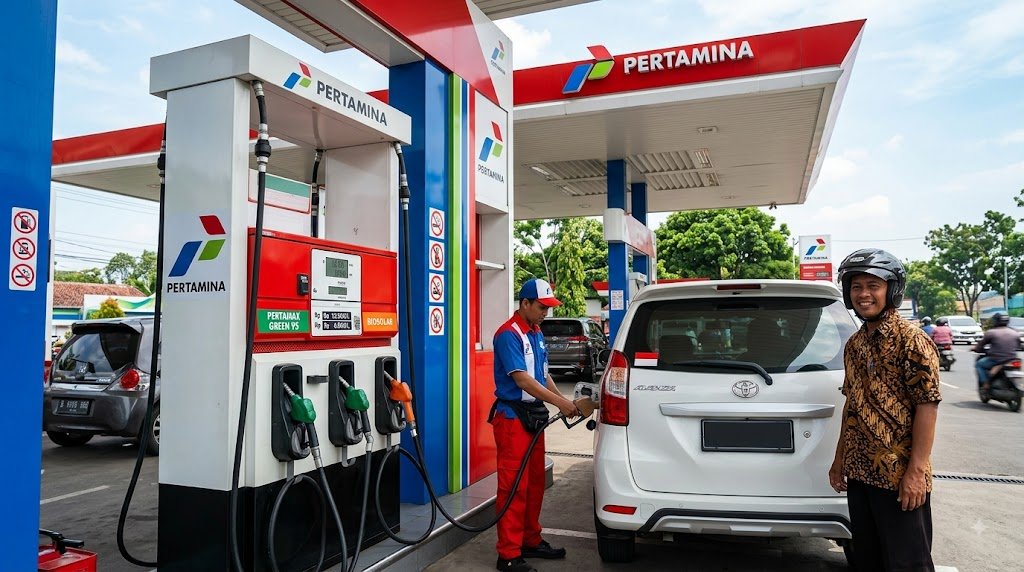
Amid these expansion plans, Indonesia has already introduced commercial bioethanol fuel at an E5 blend (5% ethanol mix) under the brand Pertamax Green 95 (RON 95) across selected Pertamina gas stations. As of August 1, 2026, Pertamax Green 95 is priced at IDR 16,600 per liter, marking a slight decrease from its July 2026 price of IDR 17,000 per liter.
CEO of Pertamina New & Renewable Energy (Pertamina NRE), John Anis, affirmed full corporate support for the government’s bioethanol roadmap. He revealed that Pertamax Green 95 is currently distributed across approximately 170 Pertamina stations in East Java and Jakarta.
To meet future demand for higher blends, Pertamina estimates that Indonesia will require 20 to 30 new bioethanol refining plants within the next two years. Establishing domestic processing infrastructure is expected to curb expensive fuel imports while directly channeling state capital into local farming communities. To realize these goals, Pertamina stressed the necessity of mandatory government regulations and raw material price stability.
Meanwhile, the Ministry of Energy and Mineral Resources (ESDM) through DJEBTKE announced that the Market Index Price (HIP) for pure, unblended sugarcane-based bioethanol for August 2026 was officially set at IDR 11,695 per liter, up from IDR 10,933 per liter in July 2026.
The transition toward bioethanol forms a core pillar of Indonesia’s broader energy security strategy aimed at achieving net-zero emissions while significantly lowering dependence on imported refined petroleum. Historically, Indonesia has faced a rising current account deficit driven by heavy oil imports to feed domestic transport demand. By ramping up agricultural feedstocks like sugarcane, sorghum, and cassava, the government seeks to create a self-sustaining domestic bioenergy circular economy.
Indonesia’s bioethanol journey builds upon the structural success of its palm oil-based biodiesel program (such as B35 and B50 mandates), which positioned the country as a world leader in biodiesel utilization. However, expanding bioethanol faces distinct operational challenges compared to biodiesel, primarily due to feedstock supply constraints and the high capital cost required to build specialized distillation refineries.
Industry analysts note that achieving E10 or E20 nationwide will require close cross-sectoral collaboration between agricultural ministries, local farmers, state-owned enterprises, and private investors. Ensuring fair sugarcane pricing formulas and guaranteeing land availability for non-food feedstock crops will be critical steps in ensuring Indonesia’s bioethanol program achieves commercial viability without compromising national food security.