

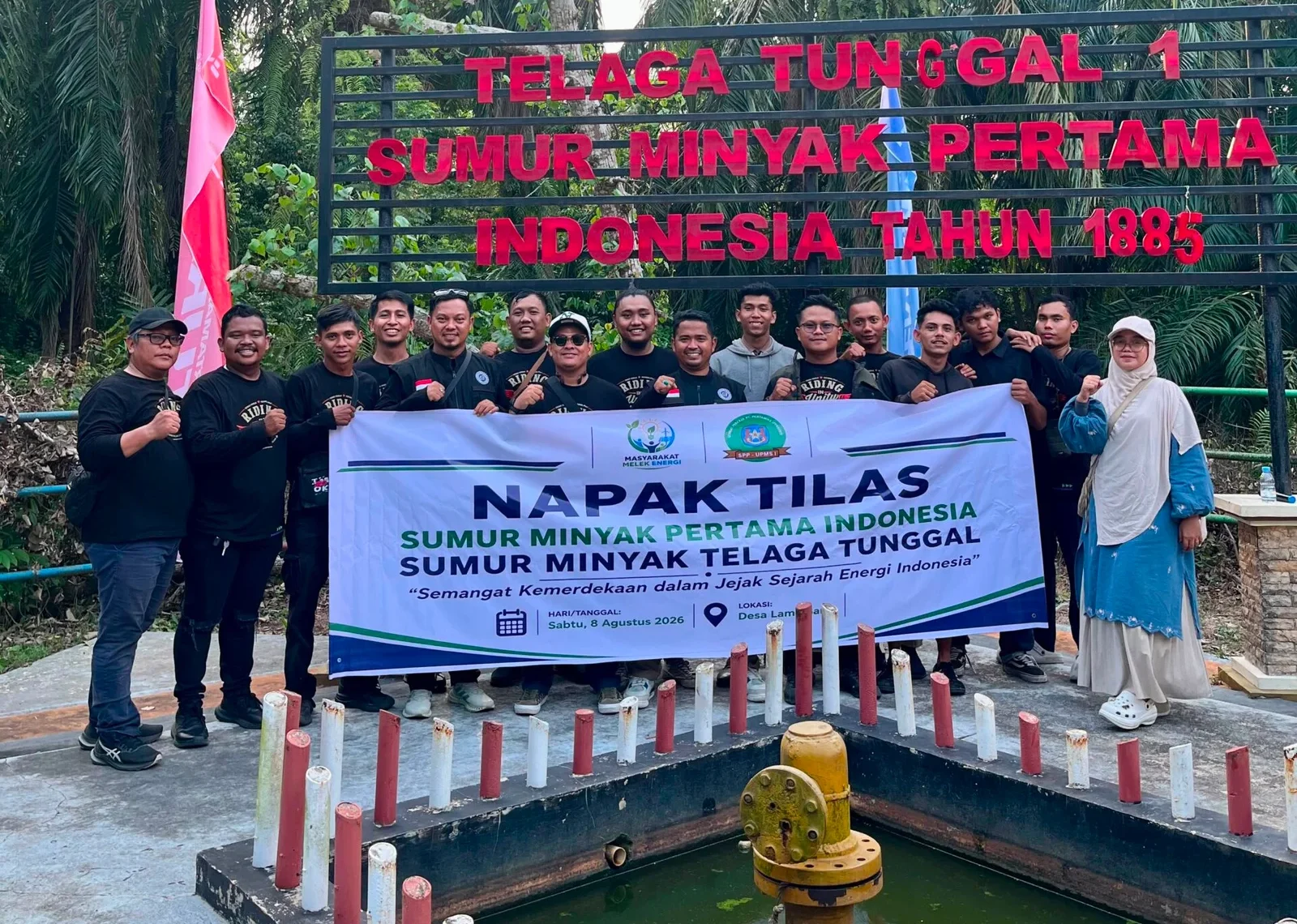
LANGKAT (METRO BUNDARAN) — The Coordinator of the Energy Literacy Society (Masyarakat Melek Energi or MME), Nugra Ferdino, has officially declared the “Guard Article 33 of the 1945 Constitution Movement” (Gerakan Kawal Pasal 33 UUD 1945) at the historic Telaga Tunggal Well, located in Lama Baru Village, Sei Lepan District, Langkat Regency, North Sumatra.
The declaration took place as part of a historical energy trail (Napak Tilas Sejarah Energi Indonesia), which included visits to the Pangkalan Brandan Oil Refinery—Indonesia’s inaugural oil refining complex—and the site of the nation’s first commercial oil well.
The selection of the Telaga Tunggal Well as the declaration venue carries deep historical significance. It was from this very site in Langkat that Indonesia’s commercial oil industry was born, marking a pivotal milestone in the country’s national energy timeline.
Telaga Tunggal stands as a symbol of Indonesia’s proud legacy as an energy-producing nation. It serves as an enduring reminder of the country’s constitutional mandate to manage natural resources in strict accordance with Article 33 of the 1945 Constitution—ensuring that energy resources are utilized for the greatest prosperity of the people.
Through the Guard Article 33 Movement, MME reaffirmed its dedication to monitoring national energy policies. The organization aims to keep these policies rooted in constitutional mandates, strengthen national self-reliance, safeguard energy sovereignty, and guarantee that oil, natural gas, and broader energy management deliver tangible benefits to all Indonesian citizens.
During the declaration, Nugra Ferdino stressed that the Guard Article 33 Movement is not merely symbolic. Instead, it represents a moral, constitutional, and patriotic crusade designed to continuously audit national energy policies and prevent deviations from constitutional principles.
Article 33 of the 1945 Constitution forms the primary cornerstone for managing Indonesia’s natural wealth. Under this constitutional foundation, all national energy resources must remain controlled by the state and directed toward maximizing public welfare.
“The Guard Article 33 Movement exists to ensure that this constitutional directive is fully realized across every national energy policy. Our objective is to establish an Indonesian energy sovereignty that is equitable, self-sufficient, transparent, and aligned with national interests,” declared Nugra Ferdino on Thursday (13/8/2026).
MME also highlighted that the struggle for energy sovereignty cannot be detached from the existence of community-managed traditional oil wells (sumur rakyat). For decades, these community wells have formed an integral part of Indonesia’s petroleum history while serving as a primary livelihood for residents in various oil-producing regions.
Consequently, MME called on the government to give greater strategic attention to traditional oil wells. Rather than treating them merely as targets for administrative enforcement or closures, the state should integrate them into the broader national energy structure.
According to MME, empowering community-managed wells requires establishing legal certainty, offering technical guidance, improving occupational safety standards, safeguarding local ecosystems, introducing modern technology, and fostering local economic empowerment.
Through these steps, traditional oil wells can operate professionally, safely, productively, and in full compliance with existing statutory regulations.
MME asserted that community oil wells must ultimately serve the community. The oil reserves situated within local areas ought to generate direct economic value for surrounding populations by creating local jobs, raising living standards, bolstering regional economies, and ensuring equitable development outcomes.
The management of natural resources should extend beyond corporate economic gain; it must act as an instrument to realize social justice as enshrined in the national constitution.
For MME, the Telaga Tunggal Well is more than a historic landmark—it stands as a stark reminder that Indonesia was once a global pioneer in energy development.
The Telaga Tunggal No. 1 well, drilled under the direction of Aeilko Jans Zijlker in 1885, marked the historical inception of Royal Dutch Shell and established Pangkalan Brandan in North Sumatra as the birthplace of Indonesia’s modern petroleum industry. For over a century, the region played a pivotal role in powering both the colonial and post-independence Indonesian economies, laying the technical foundation for state energy enterprise Pertamina.
In recent years, the management of traditional or community-operated oil wells (sumur rakyat) across regions like North Sumatra, South Sumatra, and Central Java has emerged as a major national policy debate. While regulatory bodies and state entities focus on safety, environmental protection, and legal compliance, local communities continue to rely on these heritage wells for economic survival. Civil society groups like MME advocate for balanced regulatory frameworks—such as cooperative management models (KUD) and legal partnerships with state energy companies—to formalize informal extraction while protecting community rights and local economic stability.