


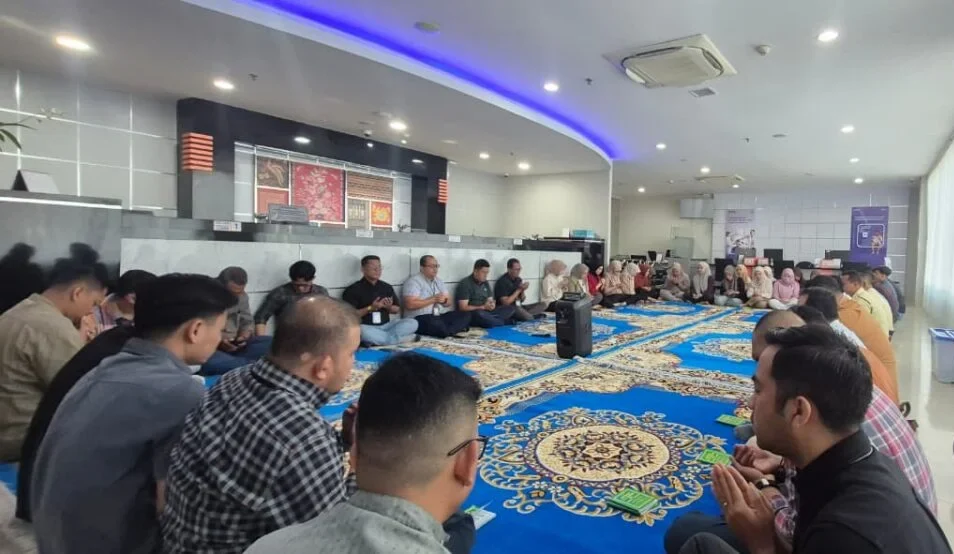
RANTAUPARAPAT – In an effort to foster workplace harmony and deepen religious values among its workforce, the Bank Rakyat Indonesia (BRI) Branch Office (BO) Rantauparapat successfully hosted a collaborative religious gathering (pengajian). The event aimed to cultivate both professional synergy and spiritual integrity within the corporate environment.
The spiritual assembly was attended by the Branch Manager of BRI BO Rantauparapat, Joy Mardian, alongside the executive board, branch employees, and members of the Ikatan Wanita BRI (IWABRI) Rantauparapat chapter. The gathering served as a vital platform to reinforce the bonds of fellowship (silaturahmi) among the extended corporate family.
In his opening remarks, Joy Mardian emphasized the profound importance of maintaining spiritual balance amidst the rigorous demands of the banking industry. He noted that incorporating regular religious gatherings into the corporate calendar helps align professional integrity with spiritual values, ultimately leading to a more grounded, dedicated, and empathetic workforce.
The event featured a powerful spiritual lecture delivered by Ustadz H. Rendi Fitrayana, Lc., M.Ag. In his sermon, the prominent cleric highlighted the essential role of faith, mutual respect, and ethical conduct in achieving meaningful success, both individually and collectively as an institution. The attendees engaged deeply with the spiritual message, which focused on translating religious integrity into daily customer service and community relations.
In the modern corporate landscape, companies are increasingly recognizing that employee productivity is closely tied to holistic well-being, which encompasses mental and spiritual health. Programs like the pengajian hosted by BRI BO Rantauparapat demonstrate a proactive approach to mitigating workplace stress and building a positive corporate culture through shared spiritual experiences.
By fostering an environment where faith and professional duties coexist harmoniously, financial institutions can cultivate higher levels of loyalty, ethical responsibility, and teamwork. In regions like North Sumatra, where community and religious values hold significant weight, such corporate initiatives also serve to strengthen the institution’s public image, portraying it not just as a commercial entity, but as a community-oriented pillar.